Poseidon Hashing - STARK with high school math part 3
Last time we succeeded at producing the following proof:
"I, prover, know a certain word w that is accepted by the automata A"
Where A is public and w "private" (not really yet, because we haven't applied out of domain randomisation, coming soon). But the problem is that no one cares about that proof. Yes the prover knows a word, but how can the verifier know it is a word that has certain properties, for examples that the word has been signed by a trusted third party (a website, government, etc...). For that we need an ID for the word that does not disclose any information. That ID it's digest (image) of a hashing function.
So we now want to prove this:
"I, prover, know a certain word w that is accepted by the automata A and h(w) = H"
Where A, H is public and h is a predetermined hash-function. Great so let's just hash the word and send the hash to the verifier. But wait? How can the verifier be sure that you indeed hashed to word w and not another one? Ok then, let's prove the hash execution using the same techniques as before (trace -> LDE -> commitment -> constraints -> FRI), I you don't understand what I'm referring to, I advise you to read part 1.
So let's chose a hash function then, sha256 the same as Bitcoin, should be secure enough. The issue is that famous hash functions like the sha-2/3 family use bit operations such as XOR which are very efficient on a computer but are very difficult to express as polynomial constraints. That is why we need hash functions that are nice to represent as polynomials. This is what we call ZK friendly hash functions. And the Poseidon hash function is on of them.
The Poseidon permutation
Poseidon in itself isn't exactly a hash function but a permutation. A permutation is the core element of a sponge construction for hash function.
The sponge construction
If you want a more detailed explanation, here is a nice ZK Whiteboard from ZKHack.
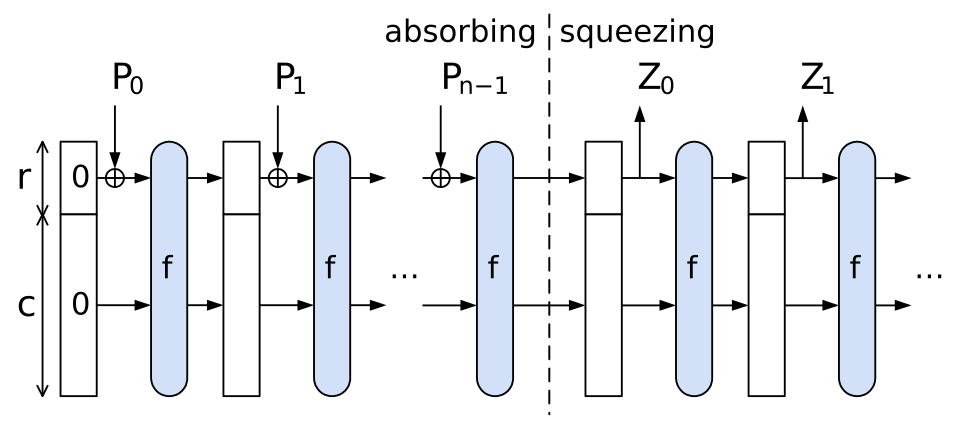
The sponge construction is a way to construct hash functions. In the simplest terms, your sponge has an internat state of size T, which is split in two parts: the rate (of size R) and the capacity (of size C).
Once its state is filled (we'll see later how), the sponge performs the permutation on its state (the squeezing phase) and then absorbs the next input in the rate part (the input is never added to the capacity part).
So for an input of size N, we need to split our input into chunks of size R (the rate size) because our sponge only absorbs chunks of size R one at a time.
Let's take an example: Let R be 3 and C be 1. Let's hash the input AMAZINGINPUT
First things firsts, the input is of size 12 (which is a multiple of 3, R) so we do not need to pad (add extra zeroes at the end).
Let's split our input in chunks of size 3: [AMA,ZIN,GIN,PUT].
At the beginning, the state is initialised with all 0 \([0;0;0;0]\)
Then we add (absorb), the first chunks into the rate \(S_0 = [A;M;A;0]\)
We apply the permutation \(\pi\) to the state so \(S_1 = \pi(S_0)\)
We add the next chunks into the state, we apply the permutation, absorb, squeeze, absorb, squeeze. Until, there's no more chunks left. Then you output the capacity part (here of size 1, which is usually the case with Poseidon as we want to output a single field element).
The Poseidon permutation
The Poseidon permutation is a loop that performs a defined number of rounds. Each round changes the state.
The Poseidon permutation is composed of full rounds and partial rounds:
Full rounds
- Add the round constants, add a constant to each cell of the state, the constants change every round
- Apply S-box, putting each cell of the state to a certain power \(x^\alpha\)
- Mix the layer, meaning multiplying the state as a column vector by a MDS matrix
Partial rounds
- Add the round constants
- Apply S-box only to the first cell of the state
- Mix the layer
To strike a balance between security and efficiency, we need to repeat the full rounds/partial rounds a certain number of times.
The Poseidon chose the Hades design meaning it splits the permutation into three phases:
- Partial rounds (\(R_p/2 \text{ times}\))
- Full rounds (\(R_f \text{ times}\))
- Partial rounds (\(R_p/2 \text{ times}\))
And that's it, you've got the very basics of the Poseidon hash function (now you can say that actually Poseidon is a permutation of a sponge construction, not a hash function in itself).
Now the nightmare is coming, proving Poseidon.
Proving Poseidon
To prove Poseidon, we need to do the same as we did on the automata. Create polynomial constraints (AIR) over the trace of the execution of Poseidon. Here the trace of Poseidon being the state after each round.
But the annoying part is that the behaviour of Poseidon isn't the same at each step unlike the automata, it can perform either a full round or a partial round and sometimes even absorb new input.
But after some time you have something like this:
poseidon_full_round_polynomials = mds@[(ptrace_polynomials[j](X) + hash_input_poly[j](X) + arc_polys[j](X))**5 for j in range(T)]
poseidon_partial_round_polynomials = mds@[(ptrace_polynomials[j](X) + hash_input_poly[j](X) + arc_polys[j](X))**(5 if j == 0 else 1) for j in range(T)]
X_G = Polynomial([FieldElement.one()])
Z_G = Polynomial([FieldElement.one()])
for i in range(len(ptrace)-1):
    r = i%(r_f+r_p)
    if(r < r_f/2 or r >= r_f/2+r_p):
      X_G = X_G * (X-z[i])
    else:
        Z_G = Z_G * (X-z[i])
poseidon_constraint_full_round = [(ptrace_polynomials[j](gp*X) - poseidon_full_round_polynomials[j](X))/X_G for j in range(len(ptrace_polynomials))]
poseidon_constraint_partial_round = [(ptrace_polynomials[j](gp*X) - poseidon_partial_round_polynomials[j](X))/Z_G for j in range(len(ptrace_polynomials))]
poseidon_constraints_initial = [p/(X-1) for p in ptrace_polynomials]
poseidon_output_constraint = (ptrace_polynomials[0](X)-phash[0])/(X-z[-1])
Poseidon AIR
Where mds is a MDS matrix (usually a Cauchy matrix), ptrace_polynomials is a list of the polynomial interpolation of each cell in the state, hash_input_poly a list of polynomials interpolating the input at each cell (input index mod rate), arc_polys a polynomial interpolation of the round constants (easier to handle as a polynomial, but more expensive to compute).
That's it, you've now proved the following statement:
I, prover, know a certain word w that is accepted by the automata A and h(w) = H
Or did you?
The crucial mistake
Please consider subscribing to the newsletter to read the rest of the article.